
Real product preview
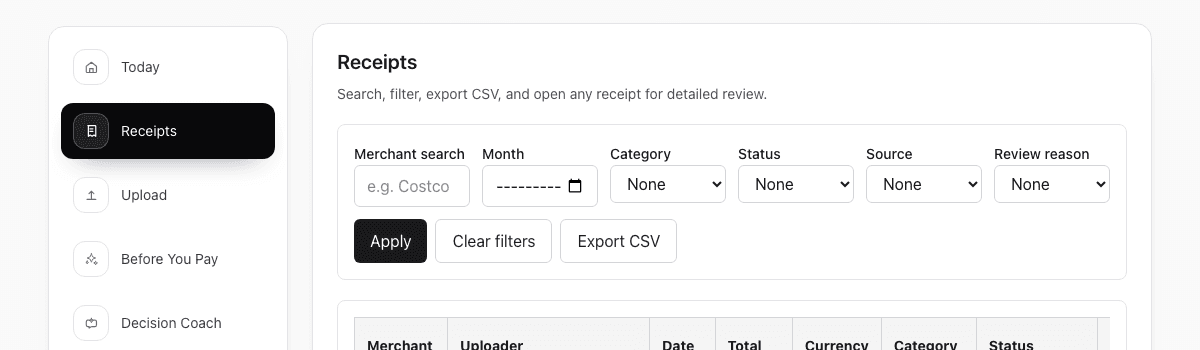
One receipt, read by OCR, tagged with its purpose, ready for review. This is the screen your team and your accountant share.
Self-employed receipt workflow
ReceiptCue helps freelancers and self-employed professionals capture receipts, review the key fields, and keep deductible records ready for tax season and accountant handoff.
ReceiptCue helps you keep proof ready. Whether an expense is deductible still depends on your situation and local rules.
Real product preview
One receipt, read by OCR, tagged with its purpose, ready for review. This is the screen your team and your accountant share.
Who this page is for
This workflow is strongest when one person has to capture receipts, remember context, and still make the record readable for tax season later.
Keep project expenses readable before deductible proof drifts into folders and memory.
Keep mixed personal and business spend from turning into a filing-season guessing game.
Hand over cleaner records instead of renamed files and one-off explanations.
Common problems
The problem is rarely that proof never existed. It is that the file, the fields, and the business context stop traveling together.
Client and expense context gets lost
A receipt might survive, but the reason it mattered to the business often does not.
Small fixes get postponed until they are expensive
A wrong amount or missing merchant is easy to fix this week and annoying to fix months later.
Tax prep becomes personal archaeology
By the time you need the proof, you are rebuilding the story instead of reusing a record.
How ReceiptCue helps
ReceiptCue focuses on keeping one trustworthy record alive from the purchase moment to the tax-season review moment.
Upload the receipt while the purchase, client, and purpose are still easy to remember.
Use OCR for the first pass, then confirm the merchant, amount, and date early.
Keep the image, searchable fields, and business context together when your accountant finally needs them.
Comparison
The issue is not whether a receipt is saved somewhere. The issue is whether the saved proof is still easy to trust and recover when you file.
| What breaks | Folder | Spreadsheet | ReceiptCue |
|---|---|---|---|
| Original proof | Image may exist, but the important context is usually outside the file. | Context may be tracked, but the original proof is often linked loosely or not at all. | Keeps the original receipt and key details attached to the same record. |
| Searchability | Depends on filenames and memory. | Depends on row hygiene and manual linking. | Find the record by receipt details instead of guessing where the file lives. |
| Field review | No built-in workflow for checking merchant, amount, or date. | Possible, but fully manual. | OCR gives a first pass and review keeps the record trustworthy. |
| Shared review | Hard to know what was checked or still missing. | Easy to edit, harder to trust. | Supports collaborative review without turning every reviewer into an uncontrolled editor. |
| Filing season readiness | Usually becomes a manual reconstruction project. | Still requires chasing original proof and mismatched rows. | Keeps proof readable and easier to export or revisit when filing season arrives. |
Start today
Upload it, write one line about what it was for, and see exactly what your accountant will see.
No credit card required. No bank login.
Tax receipt FAQ
These are the questions people usually ask when they realize saving the image is not the same as keeping a usable record.
Yes. Digital receipt records are often easier to search and review later, as long as the original proof and the important details stay together. Local rules still apply.
At minimum, keep the original receipt image plus the merchant, amount, date, and enough context to understand what the purchase was for.
Because storage alone does not make the proof easy to review later. Tax-season work breaks when the image, the details, and the business context are scattered across different places.
No. The important part is keeping the original proof and the key details together while the purchase is still fresh. Clean structure matters more than perfect filenames.
Yes. ReceiptCue supports accountant-friendly access patterns so records can be reviewed without treating every collaborator like a full editor.
No. ReceiptCue helps you organize proof and keep records usable later. Deduction eligibility still depends on your situation and local rules.