
Real product preview
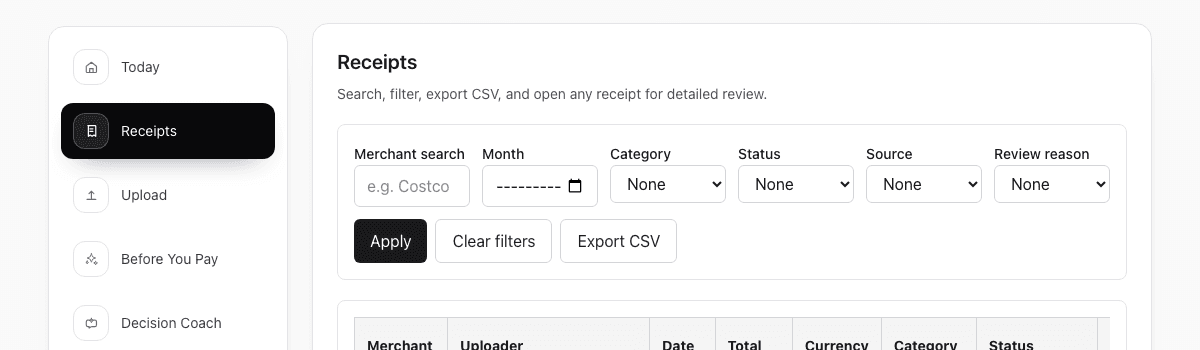
One receipt, read by OCR, tagged with its purpose, ready for review. This is the screen your team and your accountant share.
Tax-season checklist
This page turns the tax-season receipt workflow into a short checklist so you can clean up the right things before filing and accountant review begin.
This is an organizational checklist, not tax advice. Deductibility still depends on your situation and local rules.
Real product preview
One receipt, read by OCR, tagged with its purpose, ready for review. This is the screen your team and your accountant share.
Who this page is for
This checklist is useful when the real goal is not just saving files, but making receipts easier to trust and easier to hand off later.
Use the checklist to keep deductible records cleaner before filing pressure builds.
Use the checklist to spot weak proof before the accountant has to ask for it.
Use the checklist to keep the handoff closer to review-ready.
What usually goes wrong
Most filing-season pain is not exotic. It usually comes from missing proof, weak fields, or no short explanation for why the purchase mattered.
The original proof is harder to read than expected
The file may exist, but it is blurry, buried, or detached from the record you actually review.
Important fields were never confirmed
Merchant, amount, date, or category issues survive longer than they should because no one checked them early.
The business context is still only in someone’s head
The accountant receives the file but still has to ask what it was for.
Checklist steps
This is the minimum cleanup pass that usually prevents much larger tax-season archaeology later.
Make sure the receipt image or PDF is attached, readable, and still connected to the record you will search later.
Confirm merchant, amount, date, and category while the purchase still makes sense to you.
Add enough context so an accountant or reviewer can understand why the purchase mattered without chasing you first.
Start today
Upload it, write one line about what it was for, and see exactly what your accountant will see.
No credit card required. No bank login.
Tax receipt FAQ
These are the questions people usually ask when they realize saving the image is not the same as keeping a usable record.
Yes. Digital receipt records are often easier to search and review later, as long as the original proof and the important details stay together. Local rules still apply.
At minimum, keep the original receipt image plus the merchant, amount, date, and enough context to understand what the purchase was for.
Because storage alone does not make the proof easy to review later. Tax-season work breaks when the image, the details, and the business context are scattered across different places.
No. The important part is keeping the original proof and the key details together while the purchase is still fresh. Clean structure matters more than perfect filenames.
Yes. ReceiptCue supports accountant-friendly access patterns so records can be reviewed without treating every collaborator like a full editor.
No. ReceiptCue helps you organize proof and keep records usable later. Deduction eligibility still depends on your situation and local rules.