
The file exists but the story is missing
An accountant can see the receipt and still not know what it was for or who made the purchase.
Accountant-ready receipt handoff
Short answer
Give your accountant each receipt with its date, seller, total, sales tax and one line on what it was for, matched to the bank or card line that paid for it. Sort them by month and say which were paid personally. Keep the originals for six years, as the CRA asks.
ReceiptCue helps people and small teams prepare receipt records that accountants can review without first untangling folders, screenshots, and spreadsheet notes.
ReceiptCue helps organize the handoff. Tax conclusions and bookkeeping treatment still depend on your accountant and your situation.
Common problems
The receipt image might survive, but the business reason, review status, and missing-field cleanup often do not.
The file exists but the story is missing
An accountant can see the receipt and still not know what it was for or who made the purchase.
Questions arrive when no one remembers the details
A missing merchant, date, or explanation is much harder to fix at quarter-end than the same week.
Read-only review is hard in manual systems
Folders and spreadsheets make it easy to over-share editing and hard to preserve trust in the record.
How ReceiptCue helps
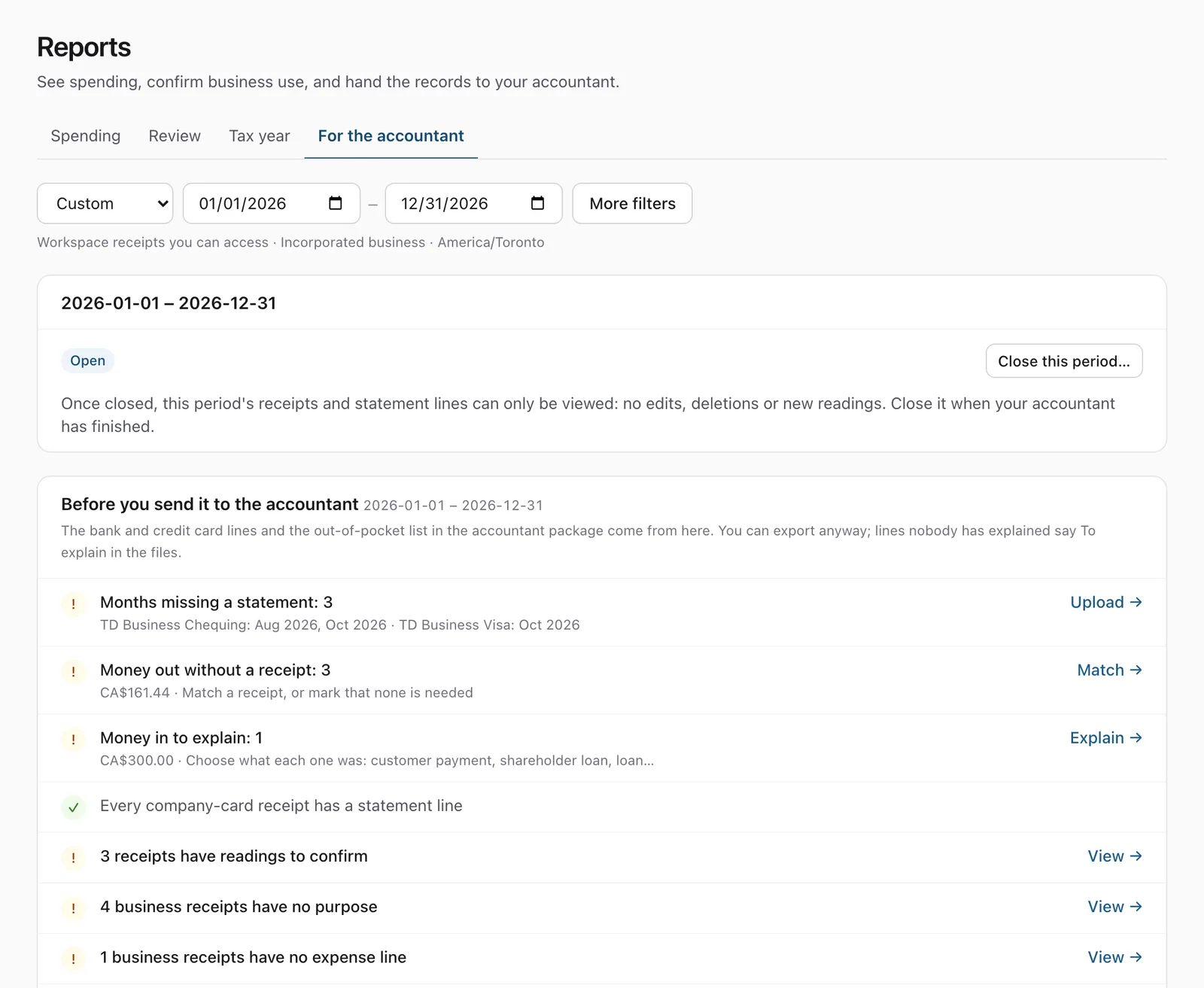
Ask your accountant which date range and file format they need. Then work through the receipts in that period, keeping unresolved questions separate from confirmed details.
Open the original image or PDF. Check the merchant, purchase date, currency, total, and tax shown against the recorded fields. Check for duplicate uploads. If the image is cut off or unreadable, ask the purchaser for a clearer copy before handoff.
Write what was bought, the project or business activity, and who paid. For example: “Printer paper for the Oak Street installation; paid personally by Mei.” Record the business line and flag mixed personal/business purchases for your accountant instead of guessing a deduction.
Filter the period, resolve missing purposes and fields, and make a short list of open questions. Invite the accountant with the access the owner has chosen, or download the accountant package (Pro and Team). Confirm they can open the original proof as well as the summary; a CSV alone is not the receipt.
Why not a folder or spreadsheet?
The problem is not storage. It is that the purpose, the proof, and the person who knows are in three different places by tax time.
| What breaks | Folder | Spreadsheet | ReceiptCue |
|---|---|---|---|
| Capture speed | Save files somewhere and hope you rename them later. | Track the purchase separately from the actual receipt image. | Capture the receipt and keep the file attached to the record from the start. |
| Search and retrieval | Relies on memory, filenames, and manual sorting. | Relies on manual row hygiene and matching cells back to files. | Keeps the proof and key details together in one searchable workflow. |
| Purpose and context | Nobody remembers what the receipt was for by tax time. | A notes column, if anyone fills it in. | The person who spent adds the purpose on the receipt, and earlier purposes for the same shop are offered. |
| Shared review | Hard to know who checked what. | Easy to edit, harder to trust. | Supports shared visibility and accountant-friendly review across workspaces. |
| Who is behind | You find out in March. | Only if someone reconciles by hand every month. | Receipts missing a purpose are flagged, and one click reminds the right person (Pro and Team). |
| Bank and card statements | A pile of PDFs, matched by hand. | Copy, paste, then search. | Each charge is matched to its receipt. |
Sources
Updated November 14, 2026. Tax rules change; check the CRA page before you rely on a detail.
Free plan. No credit card.
Accountant handoff FAQ
When the pain is really about handoff quality, these are usually the first questions that come up.
Attach readable original proof and confirm the merchant, date, currency, total, and tax shown. Add a short business purpose, the business line or project, and who paid. Flag uncertainties for your accountant rather than filling them with guesses.
No. The earlier you capture and review the record, the easier it is to keep the important context attached.
Yes. Accountants can review and export receipts. The workspace owner can separately enable receipt classification access; without that permission, the accountant is read-only.
A spreadsheet can work for a small volume if each row reliably links to readable original proof and includes the business purpose and payer. When several people contribute, a shared receipt workflow can reduce missing attachments and follow-up questions.
Yes. A cleaner accountant handoff usually improves the same records you need for reimbursements and tax-season review.
No. ReceiptCue helps organize proof and handoff quality. Accounting treatment still depends on your accountant and your situation.