
Real product preview
One receipt, read by OCR, tagged with its purpose, ready for review. This is the screen your team and your accountant share.
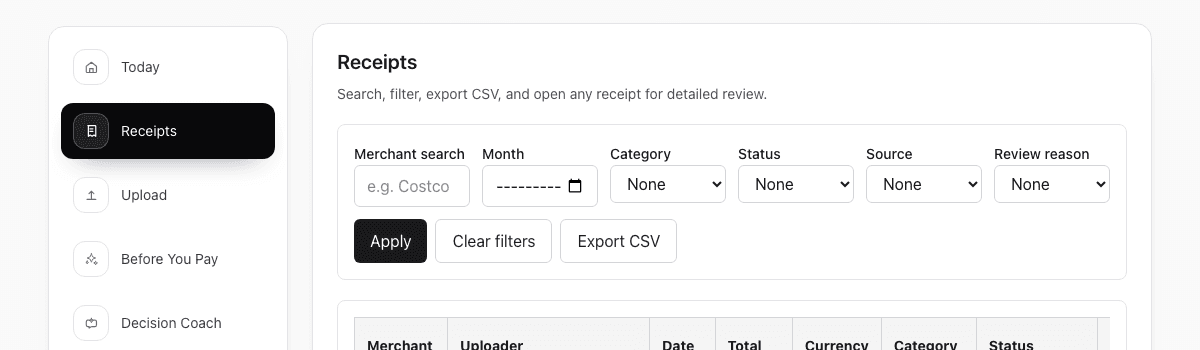
Reimbursement-ready receipt proof
ReceiptCue helps you capture receipts, keep the important details attached, and reuse the same proof when it is time to submit reimbursement claims or answer follow-up questions.
ReceiptCue helps keep proof organized and easy to review. Reimbursement approval still depends on your employer or program rules.
Real product preview
One receipt, read by OCR, tagged with its purpose, ready for review. This is the screen your team and your accountant share.
Who this page is for
This workflow is strongest when reimbursement depends on keeping the original receipt and its supporting details easy to recover later.
Capture proof while the trip, meal, or purchase is still recent so the claim is not rebuilt from memory.
Review cleaner records with less guessing about which file belongs to which claim.
Keep one workflow for proof, review, and shared visibility instead of scattered folders and manual trackers.
What usually goes wrong
Most reimbursement delays happen because the proof was captured late, stored badly, or separated from the details reviewers actually need.
Receipts disappear before the claim exists
By the time someone opens the reimbursement form, the proof may already be sitting in a wallet, folder, or phone gallery with no structure.
Details are missing when review starts
Merchant, amount, date, or category questions show up later, after the person who made the purchase has already moved on.
Manual trackers create more follow-up
A spreadsheet can record the claim, but it usually does not keep the proof organized enough to answer review questions quickly.
How ReceiptCue helps
ReceiptCue focuses on making the record reusable later, not just scanned once.
Upload the receipt while the purchase is still fresh instead of waiting for end-of-month cleanup.
Use OCR as the first pass, then verify the amount, merchant, and date before the reimbursement request depends on bad data.
Keep the proof image and its searchable details together so the reimbursement flow is easier to complete and easier to defend.
Comparison
The hard part is not saving a file somewhere. The hard part is keeping the proof readable, trustworthy, and easy to review when the claim is submitted.
| What breaks | Folder | Spreadsheet | ReceiptCue |
|---|---|---|---|
| Receipt capture | Proof may land in a file system, but not in a reusable claim workflow. | Claim row may exist before the original proof is attached cleanly. | Capture the proof and its details into the same workflow from the start. |
| Submission readiness | Requires manual hunting when the form is finally opened. | Rows are easy to update, but the proof still has to be chased. | Keeps proof and key details together so the record is easier to reuse later. |
| Reviewer questions | No clear workflow for clarifying amount, merchant, or date. | Possible, but fully manual and easy to drift from the source image. | Review the important fields early while the purchase is still easy to remember. |
| Shared visibility | Hard to tell what is missing, pending, or already reviewed. | Shared, but easy to overwrite or mistrust. | Supports shared visibility and structured review across a workspace. |
| Later retrieval | Often becomes filename archaeology. | Still depends on row quality and manual links back to proof. | Makes the claim evidence easier to recover when follow-up happens later. |
Start today
Upload it, write one line about what it was for, and see exactly what your accountant will see.
No credit card required. No bank login.
Reimbursement FAQ
These are the questions people usually ask when reimbursement pain starts after the purchase, not at the claim form.
As soon as practical after the purchase. The sooner the proof is captured, the easier it is to keep the details accurate and the record usable later.
Keep the original receipt image plus the merchant, amount, date, and enough context to understand what the purchase was for.
A spreadsheet can track claims, but it usually does not keep the original proof organized enough to answer review questions quickly.
No. It is better to capture the receipt and review the key details soon after the purchase, then reuse the same record when the claim is ready.
Yes. ReceiptCue supports workspace-based visibility so the same record can be captured by one person and reviewed by another.
Yes. ReceiptCue is designed to support reviewer access without assuming every collaborator should have full edit control.